A Rhythm of Prayer Centred upon Christ
Prayer lies at the heart of Christian life. Through prayer, we praise Almighty God, confess our sins, give thanks for His mercies, bring before Him our needs, and learn to rest more deeply in His presence. Throughout Christian history, believers have used various patterns and disciplines to help focus the mind and heart upon God.
The Anglican Rosary, also known as Anglican Prayer Beads, is one such devotional aid. It provides a simple rhythm for prayer, meditation, and the repetition of passages from Holy Scripture. Unlike the Sacraments or the forms of public worship appointed by the Church, the Anglican Rosary is not required of Christians. It is a private devotional practice that some Anglicans find helpful in maintaining attention and establishing a regular habit of prayer.
Its true value does not lie in the beads themselves, but in whether their use directs the heart towards God through Jesus Christ.
“Pray without ceasing.”
— 1 Thessalonians 5:17
What Is the Anglican Rosary?
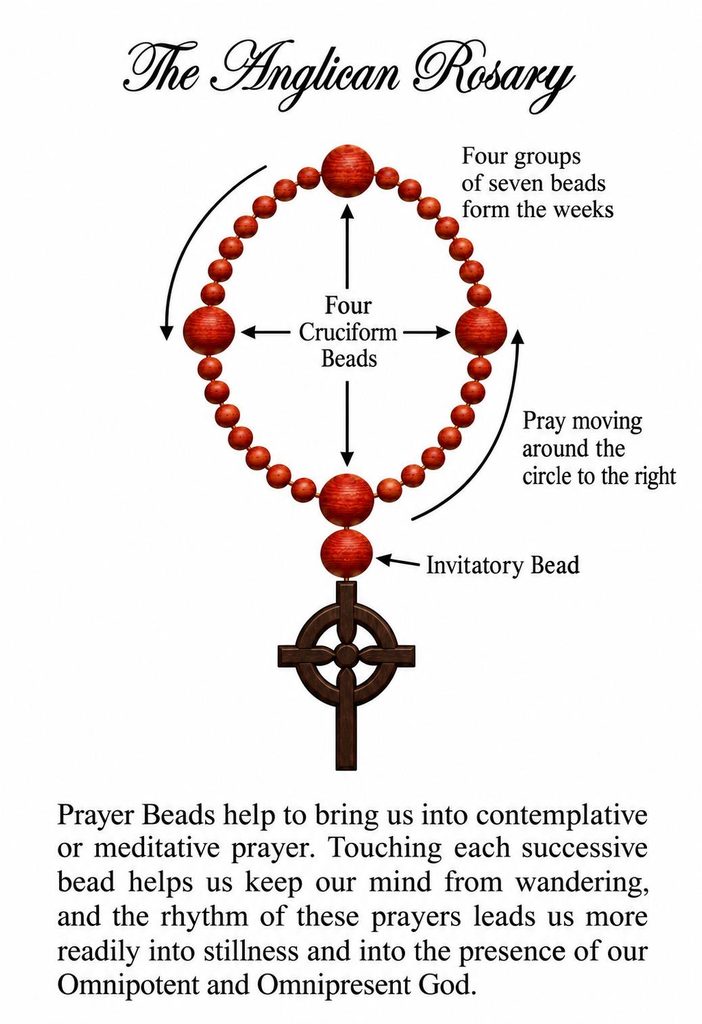
The Anglican Rosary is a set of prayer beads arranged in a distinctive pattern. A common form contains thirty-three beads, a number traditionally associated with the earthly life of our Lord Jesus Christ.
The beads are generally arranged as:
- One Invitatory bead
- Four Cruciform beads
- Twenty-eight Week beads, arranged in four groups of seven
- A Cross
The four larger Cruciform beads divide the circle into four sections. Between them are groups of seven smaller beads known as Weeks.
This arrangement gives the worshipper a structure through which prayers, Psalms, Scriptural passages, or short Christian petitions may be repeated thoughtfully.
There is no single compulsory set of prayers for Anglican prayer beads. Their flexibility allows them to be used with prayers drawn directly from Holy Scripture, the Book of Common Prayer, or other Christ-centred devotions consistent with Christian faith.
Prayer and Holy Scripture
One of the most fruitful ways to use Anglican prayer beads is to unite them with the words of Scripture.
The Psalms repeatedly demonstrate the importance of meditating upon God’s Word:
“O how love I thy law! it is my meditation all the day.”
— Psalm 119:97
A short verse may be repeated slowly while moving from bead to bead. This is not intended as empty repetition. Rather, the words are considered prayerfully so that the mind remains fixed upon their meaning.
The words of our Lord may likewise become the focus of meditation:
“Abide in me, and I in you.”
— St. John 15:4
Such a short passage can become a profound prayer. Repeated slowly and reverently, it invites the Christian to consider what it means to abide in Christ and depend upon Him.
Not Vain Repetition
Our Lord warned His disciples:
“But when ye pray, use not vain repetitions, as the heathen do.”
— St. Matthew 6:7
This warning is important whenever repeated prayers are used.
Christ does not condemn all repetition in prayer. In Gethsemane, He prayed again using the same words (St. Matthew 26:44). Scripture also contains repeated praises, including the recurring declaration that God’s mercy “endureth for ever” throughout Psalm 136.
The distinction is between mindless repetition and attentive prayer.
Prayer beads should never become a mechanical exercise in which words are spoken while the heart remains far from God. Their purpose is precisely the opposite: to help gather a distracted mind and direct it towards the Lord.
The beads themselves possess no spiritual power. They are simply a physical aid to prayer.
Christ at the Centre
Any authentically Christian use of prayer beads must remain centred upon Jesus Christ.
He is our Mediator and the One through whom we approach the Father:
“For there is one God, and one mediator between God and men, the man Christ Jesus.”
— 1 Timothy 2:5
The Anglican Rosary may therefore be used for meditation upon the life and teaching of Christ, His Incarnation, Passion, Resurrection, Ascension, promises, and commandments.
A believer might pray with such words as:
“Lord Jesus Christ, Son of God, have mercy upon me.”
Or with the prayer of the blind men recorded in the Gospel:
“Thou son of David, have mercy on us.”
— St. Matthew 9:27
Another simple meditation may use the words:
“Speak, LORD; for thy servant heareth.”
— 1 Samuel 3:9
The important matter is not the particular formula but the direction of the heart towards God in faith.
The Cross
Many Anglican prayer beads begin and end with a Cross. This provides an appropriate reminder that Christian prayer rests upon the saving work of Jesus Christ.
The Cross stands at the centre of our redemption.
St. Paul writes:
“But God forbid that I should glory, save in the cross of our Lord Jesus Christ.”
— Galatians 6:14
Beginning prayer at the Cross can remind us that we approach Almighty God not because of our own righteousness but because of His mercy revealed in Christ.
It also reminds us of our baptismal calling to follow the Lord faithfully:
“If any man will come after me, let him deny himself, and take up his cross daily, and follow me.”
— St. Luke 9:23
Thus the Cross is not merely an ornament attached to the beads. It points the worshipper towards the foundation of Christian hope.
The Invitatory Bead
After the Cross comes the Invitatory bead. Its name reflects an invitation or entrance into prayer.
A Christian may use this bead to begin with words from the Psalms:
“O Lord, open thou my lips; and my mouth shall shew forth thy praise.”
— Psalm 51:15
This familiar Scriptural petition is also deeply rooted in Anglican worship. It reminds us that even our ability to pray rightly depends upon God’s grace.
The Invitatory may also be used for the Lord’s Prayer, a Collect, or another suitable prayer of preparation.
The Cruciform Beads
The four Cruciform beads form the principal divisions of the Anglican Rosary.
These may be used for a recurring prayer, a verse of Scripture, or words of praise. For example:
“Holy, holy, holy, Lord God Almighty, which was, and is, and is to come.”
— Revelation 4:8
The repetition of such words can turn the mind away from everyday distractions and towards the holiness and majesty of God.
The Seven-Bead Weeks
Between the Cruciform beads are four groups of seven beads.
Seven is a number frequently encountered in Scripture, and the groups provide a natural rhythm for meditation. On these beads, a Christian may repeat a short prayer or meditate upon a chosen passage.
For example:
“Create in me a clean heart, O God; and renew a right spirit within me.”
— Psalm 51:10
Another prayer might simply be:
“Lord, increase our faith.”
— St. Luke 17:5
The purpose is not to complete a required number of repetitions. Rather, the rhythm gives the mind sufficient time to dwell upon the prayer and allow its meaning to penetrate beyond hurried speech.
Prayer with the Book of Common Prayer
Anglicans possess a particularly rich treasury of prayer in the Book of Common Prayer.
Its Collects, Canticles, Penitential prayers, and Scriptural forms may provide material for meditation with prayer beads. Short portions may be selected and prayed slowly, allowing familiar words to be considered more deeply.
The Anglican Rosary should not replace Morning Prayer, Evening Prayer, Holy Communion, the reading of Scripture, or the corporate worship of the Church. Instead, where it is used, it may supplement these established disciplines as part of private devotion.
A Simple Pattern of Anglican Rosary Prayer
There is no universally prescribed Anglican Rosary devotion, but a simple Christ-centred pattern may be used.
At the Cross, begin in the Name of the Father, and of the Son, and of the Holy Ghost.
At the Invitatory bead, pray the Lord’s Prayer.
At each Cruciform bead, pray:
“Holy, holy, holy, Lord God Almighty.”
At each of the seven Week beads, pray:
“Lord Jesus Christ, Son of God, have mercy upon me.”
After completing the circle, conclude with thanksgiving, a Collect, or the Gloria Patri:
“Glory be to the Father, and to the Son, and to the Holy Ghost;
As it was in the beginning, is now, and ever shall be, world without end. Amen.”
This is only one possible pattern. Christians who use Anglican prayer beads may adapt their devotions according to the seasons of the Church year or particular spiritual needs, provided that prayer remains faithful to Holy Scripture and centred upon God.
An Aid, Not an Obligation
It is important to understand the proper place of the Anglican Rosary.
The Christian faith does not depend upon possessing or using prayer beads. They are neither a Sacrament nor a requirement for salvation. Christians may live rich and faithful lives of prayer without ever using them.
For those who find them beneficial, however, the beads may serve as a simple discipline—particularly when distraction makes sustained prayer difficult.
The physical movement from bead to bead can slow the pace of prayer, encourage attentiveness, and create space for meditation upon God’s Word.
But the outward practice must always serve the inward purpose.
Our Lord teaches:
“God is a Spirit: and they that worship him must worship him in spirit and in truth.”
— St. John 4:24
Be Still Before God
In a world filled with noise and constant distraction, Christians need moments of stillness before the Lord.
The Psalmist declares:
“Be still, and know that I am God.”
— Psalm 46:10
The Anglican Rosary can provide one way of entering such stillness. Through Scripture, repeated prayer, silence, and meditation, the believer is encouraged to turn away temporarily from surrounding distractions and give undivided attention to God.
Yet the goal is never simply to complete a circle of beads.
The goal is communion with God.
Whether we pray with prayer beads, from the Book of Common Prayer, through the Psalms, in the silence of our hearts, or together with the congregation, all true Christian prayer finds its centre in the God who has revealed Himself through Jesus Christ.
The Anglican Rosary, when used wisely, may therefore become a quiet companion in the life of faith—not an object of devotion in itself, but an aid directing the mind towards Scripture, the heart towards prayer, and the soul towards Christ.
“Continue in prayer, and watch in the same with thanksgiving.”
— Colossians 4:2