The Bearer of the Catholic Faith from Jerusalem to the British Isles
The Apostolic Origins of the Church in Britain
Introduction: A Forgotten Chapter of Christian History
The history of Christianity in Britain must not begin with St. Augustine of Canterbury in AD 597. Christianity was already established in Britain centuries before his arrival. The question of how the Faith first reached these islands remains an important subject of historical investigation.
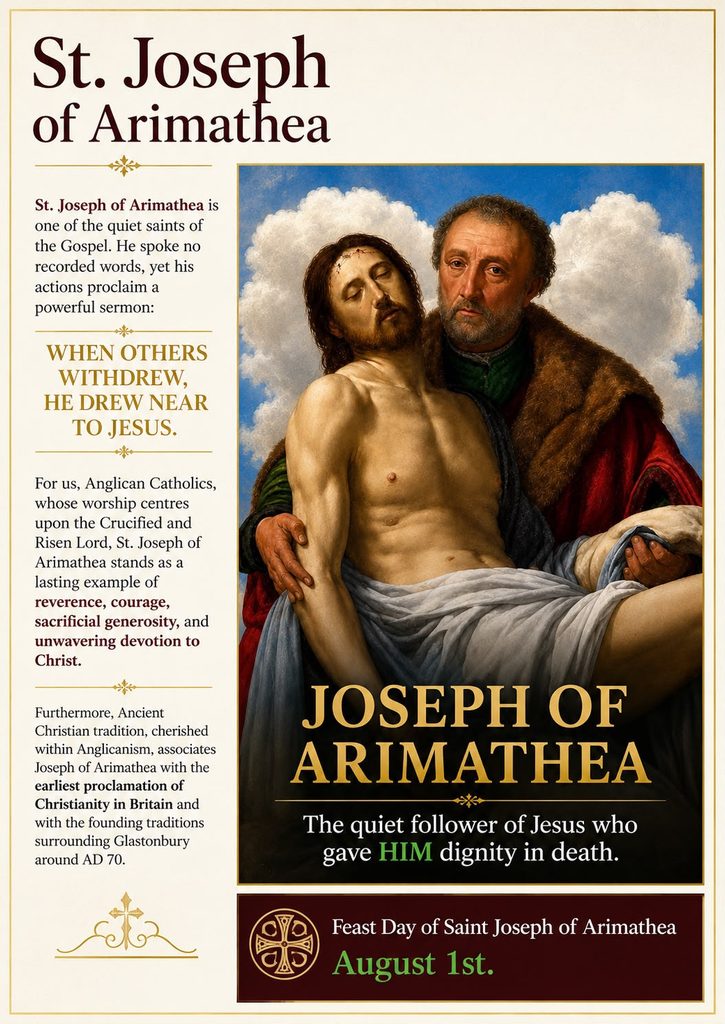
One ancient British tradition identifies St. Joseph of Arimathea—the disciple who received the body of Jesus and laid Him in his own tomb—as a bearer of the Christian Faith to Britain.
This article advances the proposition that St. Joseph brought the Catholic Faith, understood in its original sense as the universal Christian Faith, from Jerusalem to the British Isles. It examines that proposition through the Glastonbury tradition, the historical evidence for early British Christianity, and the distinction between the ancient Church in Britain and the later Church of England.
The distinction between tradition and documentary evidence must remain clear.
- St. Joseph of Arimathea: The Disciple Who Served Jesus
The New Testament introduces St. Joseph of Arimathea as a respected member of the Jewish council and a disciple of Jesus.
St. Mark records:
“He went to Pilate, and begged the body of Jesus.” — St. Mark 15:43, Authorised King James Version.
St. Joseph’s courageous act placed him among those who served Jesus at the moment of His burial. He was directly associated with the events of the Passion and belonged to the generation that witnessed the earthly ministry of Jesus.
The Gospels do not record his subsequent movements. They neither confirm nor deny a later journey to Britain.
His alleged British mission belongs to a tradition that developed in later Christian history. It is therefore necessary to examine both the tradition itself and the historical context in which it became important.
- The Glastonbury Tradition: Jerusalem and Britain
Glastonbury, in Somerset, England, became associated with the claim that the Christian Church in Britain possessed an apostolic foundation.
According to the tradition, St. Joseph travelled to Britain with companions and established an early Christian community at Glastonbury, traditionally dated to AD 63. The story connects Britain with the earliest generation of Christians and presents the British Church as a recipient of the universal Faith that originated in Jerusalem.
The tradition subsequently associated St. Joseph with the Holy Grail and the sacred origins of British Christianity.
The historical qualification is important. The surviving association of St. Joseph with Glastonbury belongs to the medieval period. The twelfth-century writer William of Malmesbury described Glastonbury’s early Christian claims, but the specific identification of St. Joseph as its founder entered the surviving Glastonbury tradition later.
Consequently, the traditional date of AD 63 cannot be treated as a date established by contemporary documentary evidence.
Nevertheless, the tradition deserves examination as part of the historical memory of British Christianity. It provides a particular answer to the question of how the Gospel might have reached Britain during the apostolic age.
- What Does It Mean to Bring the Catholic Church to Britain?
The word Catholic means universal. The Catholic Church, in its fundamental sense, is the universal Christian Church founded by Jesus and established through the Apostles.
The Christian proclamation began in Jerusalem. From there, the Apostles and their successors carried the Gospel beyond Judaea into the wider world.
If St. Joseph of Arimathea brought the Christian Faith to Britain around AD 63, as the Glastonbury tradition maintains, he would have brought the Faith of the early Church: the proclamation of Jesus, crucified and risen, and the Christian life arising from that proclamation.
The expression Catholic Church in this article refers to the universal Church, not exclusively to the later Roman Catholic ecclesiastical institution. The later denominational divisions of Christianity must not be projected backwards indiscriminately onto the first century.
The proposition advanced here is that Britain may have received the universal Christian Faith through a disciple associated with the earliest generation of believers, long before the missions documented in later British history.
This is a historical and theological thesis. Its significance must be considered alongside the evidence that Christianity was established in Britain well before AD 597.
- A Necessary Distinction: The Roman Empire and the Roman Catholic Church
The word Roman must never be used ambiguously in discussing the origins of Christianity in Britain.
The Roman Empire was the political and territorial power that governed Britain during the Roman period. Roman imperial rule brought Britain within the Empire’s administrative and military system. It did not, by itself, establish the presence of any particular Christian ecclesiastical institution.
The Roman Catholic Church is a distinct ecclesiastical institution whose later historical development must not be confused with the political history of the Roman Empire.
Similarly, a Roman-period building means a building dating from the period of Roman imperial rule. It does not automatically mean that the building was a Christian church, much less a church belonging to the later Roman Catholic institution.
The early Christian Church developed from its beginnings in Jerusalem and spread throughout the Roman Empire and beyond. Christians living under Roman imperial rule were members of the wider Christian Church; the political identity of the Empire did not determine the full ecclesiastical identity of every Christian community.
This distinction is especially important when considering the history of Britain. Evidence of Christianity in Britain during the Roman imperial period establishes an early Christian presence. It does not, on its own, establish the date at which a particular later ecclesiastical jurisdiction was formed.
Nor should the arrival of St. Augustine in AD 597 be described as the first arrival of Christianity in Britain. His mission, sent by Pope Gregory the Great, was directed towards the Anglo-Saxon peoples. It encountered a land in which Christianity already had a history.
- The Church in Britain Before AD 597
The antiquity of Christianity in Britain does not depend solely on the Glastonbury tradition.
The Church of England itself acknowledges the early roots of Christianity in Britain. Early Christian writers, including Tertullian and Origen, refer to Christianity in Britain in the third century. British bishops attended the Council of Arles in AD 314, and British bishops were present at the Council of Rimini in AD 359.
These events provide substantial historical evidence that Christianity was established in Britain centuries before St. Augustine arrived.
The distinction between the Church in England and the Church of England is therefore fundamental.
The Church in England refers to the Christian Church existing in England as part of the universal Church across successive historical periods. Its roots reach back through the ancient British Church, the Christian communities of the Roman period, the conversion of the Anglo-Saxons and the medieval Church.
The Church of England refers to the particular national ecclesiastical institution shaped by the later history of England, especially the changes associated with the Tudor monarchy and the English Reformation.
These terms are related, but they are not interchangeable.
St. Augustine’s mission in AD 597 was a major event in the conversion of the Anglo-Saxons. It was not the beginning of Christianity in Britain.
The Reformation reformed the Church in England. It did not create Christianity in England.
- St. Martin’s Church, Canterbury: A Witness to Early Christianity
St. Martin’s Church in Canterbury provides an important example of the Christian presence that preceded St. Augustine’s mission.
It is widely recognised as the oldest parish church in England still in continuous use. Its fabric includes material from the Roman period, but the precise original function of the earliest building is uncertain. It may have been a mortuary chapel or another kind of structure before its Christian use.
Queen Bertha of Kent, a Christian princess who married the Anglo-Saxon King Æthelberht, worshipped at St. Martin’s before St. Augustine arrived in AD 597. The early eighth-century historian St. Bede records this tradition.
The church subsequently became associated with Augustine’s mission and the conversion of the Anglo-Saxon kingdom of Kent.
St. Martin’s therefore provides a tangible historical connection with Christian worship in England before AD 597. Its history demonstrates why Augustine’s arrival cannot be equated with the first appearance of Christianity in Britain.
However, St. Martin’s does not independently prove that St. Joseph of Arimathea visited Britain or founded the Glastonbury community. Its significance lies in the separate and historically important evidence it provides for an earlier Christian presence.
- St. Joseph and the Apostolic Claim
Why, then, should St. Joseph of Arimathea be considered in any account of the origins of British Christianity?
The Glastonbury tradition places a disciple of Jesus at the beginning of Britain’s Christian story. It links Britain with Jerusalem and presents the ancient British Church as a recipient of the universal Faith entrusted to the earliest disciples.
According to the traditional chronology, St. Joseph arrived in AD 63, approximately three decades after the Crucifixion and more than five centuries before St. Augustine’s mission in AD 597.
That chronology is significant within the tradition. It places the alleged mission within the apostolic age rather than within the later medieval history of the Church.
Nevertheless, two propositions must be kept distinct.
First, Christianity existed in Britain centuries before AD 597. This is historically established by documentary evidence, including the participation of British bishops in fourth-century Church councils.
Second, St. Joseph of Arimathea personally brought the Faith to Britain, traditionally in AD 63. This remains an inherited tradition, not a journey demonstrated by contemporary historical records.
The first proposition is firmly established. The second is the authorial thesis advanced here, grounded in the Glastonbury tradition and offered for serious consideration.
Recognising that distinction does not require the dismissal of the tradition. It requires the reader to understand the difference between a received Christian tradition and a conclusion that the surviving historical evidence can conclusively prove.
- The Church in England and the Church of England
The distinction between the ancient Church in England and the later Church of England becomes particularly important when considering the reign of Henry VIII.
Christianity had existed in England for many centuries before Henry VIII. The Church in England possessed a history extending through the ancient British Church, the Anglo-Saxon period and the medieval Christian centuries.
During the sixteenth century, the English Crown asserted authority over the Church within its realm and rejected papal jurisdiction. The resulting changes transformed the institutional and constitutional relationship between the Church and the Crown.
The English Reformation did not establish Christianity in England for the first time. It changed the governance, jurisdiction and doctrinal settlement of an already ancient Christian institution.
The distinction is not merely a matter of wording. It concerns historical continuity and ecclesiastical identity.
The Church in England belongs to the history of the universal Christian Church in Britain. The Church of England is the particular national institution that emerged through the subsequent history of the English Church and its Reformation settlement.
Neither the Crown nor the Reformation created the original Christian presence in Britain.
- Author’s Position
I advance the proposition that St. Joseph of Arimathea was the bearer of the Catholic Faith from Jerusalem to the British Isles.
I base this thesis on the enduring Glastonbury tradition, which remembers St. Joseph as a link between the earliest generation of Christians and the origins of British Christianity. The traditional date of AD 63 places the alleged mission within the apostolic age.
I recognise that the surviving evidence does not conclusively establish St. Joseph’s journey. I therefore present his role as an authorial historical and theological thesis grounded in British Christian tradition, rather than as a fact proved by contemporary documentation.
My argument does not depend on confusing the Roman Empire with the Roman Catholic Church, nor on treating the Church in England as identical with the later Church of England.
The evidence for Christianity in Britain before AD 597 establishes the antiquity of the British Church independently of the Glastonbury story. St. Joseph’s traditional mission offers a possible explanation of its earliest origins, while the fourth-century evidence confirms that an established Christian community existed long before Augustine, a monk from the Roman Catholic Church’s arrival in England.
This distinction preserves both the significance of the tradition and the integrity of the historical record.
Conclusion: Jerusalem, Glastonbury and the Universal Church
The Christian Faith began its worldwide journey from Jerusalem. From there, the Gospel spread through the work of the Apostles and their successors, eventually taking root throughout Britain.
The Glastonbury tradition remembers St. Joseph of Arimathea as a link between Jerusalem and the British Isles. According to that tradition, he arrived in AD 63, bringing the universal Christian Faith to Britain during the apostolic age.
Although his personal mission cannot be established as historical fact from contemporary records, in future they may, the tradition remains a significant part of the inherited memory of British Christianity.
The wider historical evidence establishes that Christianity was present in Britain centuries before St. Augustine’s arrival in AD 597. British bishops attended the Council of Arles in AD 314 and the Council of Rimini in AD 359. St. Martin’s Church in Canterbury also bears witness to Christian worship before Augustine’s mission to the Anglo-Saxons.
These facts establish the antiquity of the Church in Britain. They must not be confused with the separate question of whether St. Joseph personally brought the Faith to these islands.
The distinction between the Church in England and the Church of England is equally essential. The ancient Church in Britain belongs to the history of the universal Church. The later Church of England developed through the subsequent ecclesiastical and constitutional history of England. The English Reformation transformed that institution; it did not create Christianity in the land.
The distinction between the Roman Empire and the Roman Catholic Church must likewise be maintained. Roman imperial rule was a political reality. The Christian Church was a religious community whose origins lay in Jerusalem and whose mission extended beyond the boundaries of any empire.
My thesis is that St. Joseph of Arimathea should be remembered as the traditional bearer of the Catholic Faith from Jerusalem to the British Isles. The Glastonbury tradition places him at the beginning of this story, while the independently established evidence of early British Christianity demonstrates the antiquity of the Church that took root in these islands.
The Church in Britain is older than the English Reformation. The Reformation reformed the Church in England; it did not create Christianity in England. And St. Joseph of Arimathea remains, in the Glastonbury tradition, a compelling figure through whom the ancient Christian inheritance of the British Isles is remembered.
Cecil K. Dewars